
EPR & ESPR — What the New EU Rules Mean for Fashion Brands
The regulatory landscape for fashion in Europe is changing rapidly.
Two key developments are shaping the industry:EPR & ESPR
1. Extended Producer Responsibility (EPR) for textiles
Under the revised EU Waste Framework Directive, Member States must introduce national textile EPR systems. From 2025 onward, countries are required to establish separate textile collection systems, and by 2028 mandatory producer responsibility schemes must be in place.
These systems require brands placing textiles on the EU market to:
Finance collection, reuse and recycling
Report volumes placed on the market
Document post-consumer treatment
Contribute to eco-modulated fee systems
The objective is to shift responsibility for textile waste from municipalities to producers and to prioritise reuse before recycling.
2. ESPR: Ban on the destruction of unsold textiles and footwear
Under the Ecodesign for Sustainable Products Regulation (ESPR), the destruction of unsold textiles and footwear will be prohibited from 2026.
This applies to apparel, footwear and related products placed on the EU market.
The aim is to prevent the disposal of new, unused goods and to encourage reuse and recirculation instead.
Operational Implications for Brands
Together, EPR and ESPR mean that brands must:
Establish structured take-back and reuse flows
Ensure unsold goods are redirected into reuse channels
Document and report volumes and treatment outcomes
Reduce reliance on disposal or incineration
Prepare for harmonised reporting requirements across EU markets
While the regulatory frameworks differ slightly between Member States, the direction is consistent: Reuse must increase. Destruction must decrease. Reporting must improve.
How Ninyes Supports These Requirements
Ninyes provides operational services that align with these regulatory developments:
B-stock resale (returns, samples, excess inventory)
Brand-owned resale channels
Take-back and post-consumer resale operations
End-of-life sorting and recycling coordination
Data reporting suitable for EPR documentation
The focus is not only on resale as a commercial channel, but on creating measurable reuse flows that can support compliance under national EPR schemes and ESPR obligations.
Why This Matters Now
From February 2027, large companies must publicly report volumes of unsold goods treated as waste under ESPR.
Destruction of unsold textiles and footwear will be banned from 2026
Textile EPR schemes are being implemented across the EU through 2025–2028
Early operational readiness reduces regulatory risk
Verified reuse data will increasingly influence fee structures
For brands operating in multiple EU markets, building structured reuse systems in advance of full enforcement provides both regulatory preparedness and operational clarity.
Ninyes provides structured reuse and grading documentation to support defensible decision-making and regulatory reporting.
Learn more about:
Ninyes and returns (such as B-stock) at TextilWirtschaft (in German)
New EU rules to stop the destruction of unsold clothes and shoes
The EU’s Proposal for EPR for Textiles
Global Fashion Agenda’s 2025 Mapping of Global EPR for Textiles
National schemes like Stichting UPV Textiel (Netherlands), Refashion (France), and Sweden’s Naturvårdsverket guidance
Textile EPR Status Q1/26 – Northern Europe at a Glance:
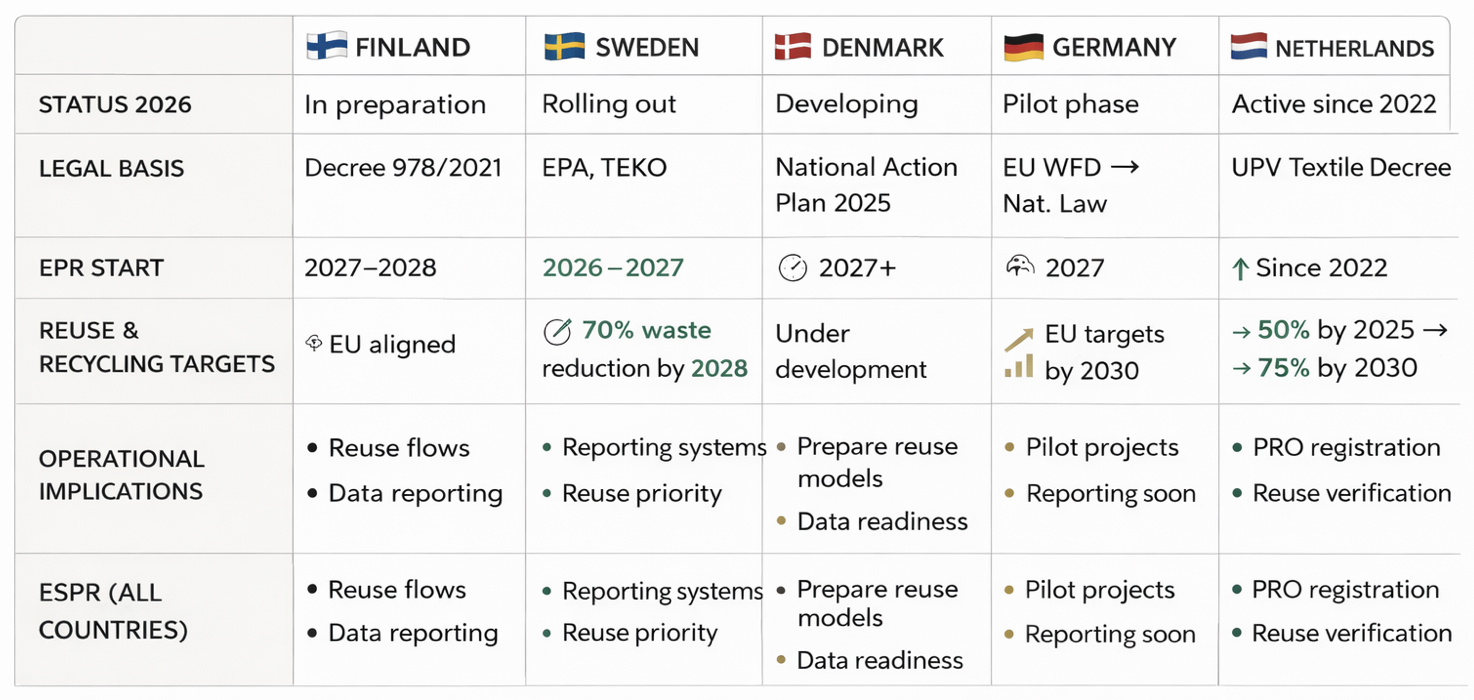
Sources: European Commission (WFD & ESPR, 2023–2026), Stichting UPV Textiel (NL), Naturvårdsverket (SE), Danish EPA, Ministry of the Environment Finland, BMUV (DE). Status as of February 2026.
©Ninyes 2026